What is a mood journal, and how do you start one?
A mood journal is a short daily note about how you feel — a single word, a rating, and a line of context. People keep one to spot patterns, sleep on a hard day, or just hear themselves think. This guide covers the basics, the research, and the five-minute starter routine.
What is a mood journal?
A mood journal is a daily record of how you felt, written by you, for you. Most entries have three parts: a label (the feeling), a rating (how strong it was), and a line of context (what was happening). That's the whole format. You can write it on paper, in a notebook, in a notes app, or in a dedicated app like Tide.
The "journal" part matters. A mood tracker usually means numbers and charts — graphs of how often you felt anxious in May. A mood diary is sometimes the same thing under a more clinical name. A mood journal keeps the act of writing front and center. You don't just rate the day; you say what was true about it. Some people call the same practice a feelings log or a mood log — the wording shifts, the idea doesn't.
People reach for one when they notice a pattern they can't explain. Sleep is fine, work is fine, but Tuesdays feel heavy. Or they're newly on a medication and want to know if it's helping. Or they're in therapy and the therapist asked. Or — most commonly — they just want a record that isn't another social feed.
A mood journal is not a diary in the long-form sense. There's no expectation of paragraphs, no audience to imagine, no chapters. It's closer to a weather log: short, frequent, and useful in aggregate. Six entries tell you nothing. Sixty start to show the shape of a season.
The point isn't completeness. The point is to make a small, honest mark each day so that the week has texture when you look back at it.
Why keeping a mood journal works
Three mechanisms do most of the work. None of them require a perfect entry, a long entry, or even a daily entry — just enough entries that you can read across them.
Naming the feeling shrinks it
Affect labeling — putting words to emotion — measurably lowers activity in the amygdala, the brain region behind the alarm-bell response to stress. A 2007 UCLA study by Matthew Lieberman and colleagues found that simply choosing a label like angry or sad for an image dampened the threat response, even when participants weren't trying to feel less of it. The act of finding the word does the work (Lieberman et al., 2007).
Writing about feelings improves outcomes
James Pennebaker's expressive writing research, replicated across forty years, found that 15–20 minutes of writing about emotionally significant events reduced doctor visits, improved immune markers, and lowered self-reported stress. The benefits show up in studies with college students, trauma survivors, laid-off engineers, and cancer patients. A mood journal doesn't replicate the full Pennebaker protocol, but the same mechanism — externalizing feeling as language — is at work (Pennebaker, multiple).
Patterns are visible only across weeks
A single bad day means little. Bad Tuesdays for six weeks in a row mean something. Mood logs make these slow patterns visible: hormonal cycles, seasonal dips, a friendship that drains you every time you see them. You can't notice from inside a day what you can notice from outside three months.
The catch: the benefits are real but modest, and they accrue. Two entries don't change your life. Sixty might change a habit. Six hundred change what you notice about yourself. Treat a mood journal the way you'd treat a sleep tracker — useful directionally, not magic.
What a mood journal is not: it's not a substitute for therapy when you need it, not a diagnostic tool, and not a productivity hack. If your moods are causing functional problems — missed work, lost sleep, withdrawal from people you love — talk to a clinician (NIMH guidance). A mood journal is the small daily practice that pairs well with the bigger work, not a replacement for it.
How to start a mood journal in 5 minutes
The starter routine has six steps. Do this once tonight and you have a journal. Repeat it tomorrow and you have a habit.
- Pick the format. Phone app, paper notebook, or notes app. Don't agonize. The format you'll actually open beats the format you wish you'd use.
- Pick a time. Right after dinner, while brushing teeth, or in bed before lights out. Tie it to something you already do.
- Pick a feeling. One word that fits the day. Anxious, fine, tired, light, restless, content. If "fine" is honest, "fine" is the right entry.
- Rate it 1 to 5. 1 is the worst day in memory; 5 is the best you can imagine. Most days are 3s. Most days are supposed to be 3s.
- Write one line of context. What was actually happening. "Slept 5 hours, ran the team meeting, walked home in the rain." Facts, not analysis.
- Stop. No paragraphs, no rewriting, no judging the entry. Ninety seconds total. Long entries are why people quit on day four.
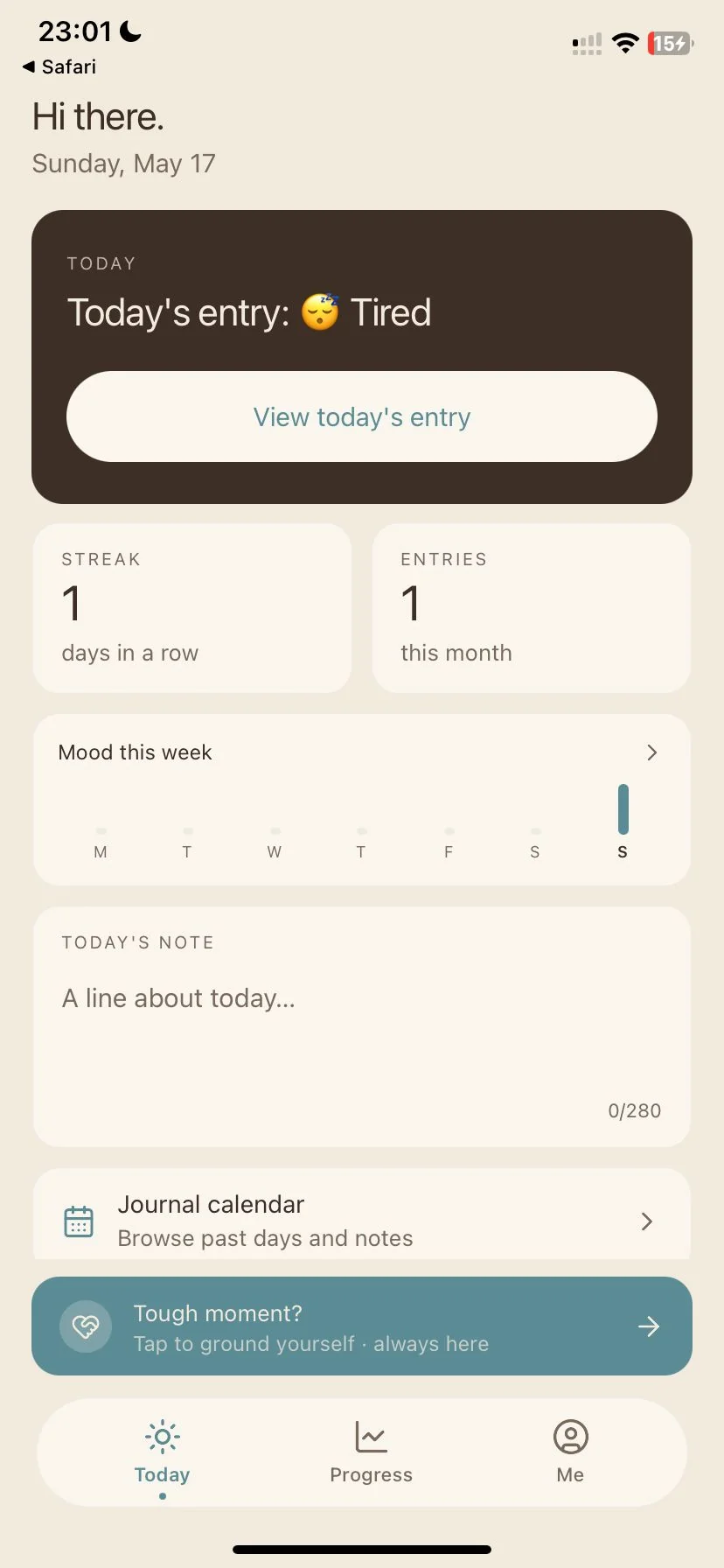
That's the whole loop. After a week you'll have a small panel of entries you can scroll back through. After a month, patterns start to show. After a season, you'll know things about yourself that no chart can tell you.
The single most common mistake is trying to make each entry mean something. Don't. The value isn't in any one entry — it's in the line you draw across them. Boring entries are the foundation of a useful mood journal.
Mood journal templates and examples
There's no single right format. What works for a person with bipolar II charting medication effects is different from what works for a college freshman tracking exam-week sleep. Pick the structure that asks you to do the smallest thing possible.
A standard daily entry looks like this:
Date: Tuesday, May 14
Mood: Heavy / 2
Note: Three meetings before lunch, didn't eat until 2. Walked home alone, felt better by the time I got there.
That's it. Add a sleep field if you suspect sleep is driving things; add a meds field if you're tracking a prescription; add a tags field if you want to filter later. Don't add a "gratitude" line, an "intention" line, and a "self-care" line all at once. The more fields, the fewer entries.
Three formats most people pick from:
- Daily one-liner — date, feeling, rating, one sentence. Best for habit-building. Our mood journal template uses this format.
- Bullet journal spread — a monthly grid you color in by mood. Slow but satisfying. See the mood bullet journal layouts.
- App-based — phone app handles the date, time, and visualization. You type the feeling and tap save. If you keep a paper bujo but also want phone access, compare bullet journal app options.
If you'd rather use paper, our mood journal PDF and mood journal printable packs cover the daily, weekly, and monthly layouts in one file. For people pairing a mood entry with one line of what went right, the gratitude bullet journal layout works well.
Mood journal for specific situations
The basics work for most people, but four situations call for small adjustments.
For depression and low mood
A mood journal can help you and a clinician separate good days from bad days more honestly than memory will. Rate before bed, not first thing in the morning — morning ratings tend to skew low even on neutral days. If you're working with a therapist, share the journal screen or printout in session.
For anxiety
Add a trigger field: what were you doing or thinking when the anxious spike started? Patterns emerge fast — caffeine, certain social settings, time of day. A two-week journal often surfaces a trigger you didn't know you had.
For bipolar disorder
A clinician-style mood chart with a 1–10 scale (rather than 1–5) is more useful here, because the goal is to catch swings as early as possible. Track sleep and medication adherence alongside mood. Bring the chart to every appointment.
For kids and teens
Use a simpler scale — color-coded faces or three emojis. The point at this age isn't analysis; it's vocabulary. A child who can say "I'm frustrated, not angry" has gained something a chart can't measure. Pair it with a feelings journal for vocabulary support.
In all four cases, the principle is the same: change one thing about the standard format to match the question you're trying to answer. Don't add four things at once. A journal you'll keep is better than a journal you'd design.
Mistakes to avoid
Five patterns tank otherwise promising mood journals.
- Writing too much. A "today I" paragraph reads like an essay assignment after two weeks. The journal becomes work, and work is the first thing you skip when the day is full. Keep entries under thirty seconds.
- Skipping bad days. The temptation is real — when the day was hard, the last thing you want is to file a record of it. But missing bad days is how mood journals lie. Even a one-letter entry on a hard day preserves the record.
- Aiming for daily before you've earned weekly. Daily is the goal, not the prerequisite. Three entries a week for two months is more useful than seven for ten days and then nothing.
- Treating the journal as a feelings essay. A mood journal isn't long-form journaling. There's no introspection requirement. "Tired, 3, long day" is a complete entry.
- Confusing the chart with the work. Some apps make beautiful weekly graphs. The graph is a side effect, not the point. Looking back at your own words from a Tuesday in March is what changes anything.
The shared pattern: making the act of journaling heavier than it needs to be. The lighter the entry, the more entries you make. The more entries you make, the more useful the journal becomes. Lightness is the strategy.
Mood journal vs related approaches
Six close-but-different practices people sometimes confuse with mood journaling.
| Practice | What it tracks | Time / day | Best for |
|---|---|---|---|
| Mood journal | Feeling + context, in your words | 1–2 min | Noticing patterns over weeks |
| Mood tracker | Numeric rating, charted | 30 sec | Visualizing trends, less detail |
| Mood diary (clinical) | Mood, sleep, medication, side effects | 2–5 min | Therapy and medication review |
| Gratitude journal | Three things that went right | 2–3 min | Reframing toward the positive |
| Bullet journal mood spread | Color-coded monthly grid | 1 min + monthly setup | Visual people, paper users |
| Long-form journaling | Free writing, paragraphs | 15–30 min | Working through specific events |
Most people end up using two of these in tandem. A mood journal as the daily anchor (low friction, every night) and a long-form entry as the weekly catch-up when something needs more thought.
If the goal is purely visual — you want a chart, not words — a mood chart tool is probably the right pick. If you want to remember a Tuesday in March, you want a journal. The difference isn't features. It's whether the entries are in your voice.
People also conflate mood journals with broader journaling, which is a free-form writing practice. The two pair well: long-form writing for the events that need processing, a mood journal for the steady daily mark. For the meta-question of which to start with, see how to track your mood.
FAQ — mood journal
What should I write in a mood journal?
One word that names the feeling, a rating from 1 to 5, and one short line of context — what was actually happening. That's the whole entry. Tired, 3, didn't sleep well, worked late. You can add fields like sleep or meds later if you're tracking something specific.
How often should I write in a mood journal?
Daily is ideal, but three to four times a week is enough to see patterns. The goal is consistency over months, not perfect daily streaks. A mood journal you keep for a year with two-day gaps beats one you abandon after twelve consecutive days.
Is a mood journal the same as a mood tracker?
Closely related, but not the same. A mood tracker is numbers-first and chart-first; a mood journal is words-first. Most modern apps blur the line — they ask for a label, a rating, and a note, then generate the chart for you. Tide is one of these.
Do mood journals actually work?
The mechanisms are well-studied: affect labeling lowers stress reactivity, expressive writing improves health outcomes, and patterns become visible across weeks. The effects are modest and cumulative — not life-changing on day three, often meaningful by month three.
What's the best app for a mood journal?
The best app is the one you'll actually open every day. That usually means fast (a few seconds to log), private (no account required), and pleasant to look at. Tide is built around the five-second entry specifically; Daylio, Stoic, and How We Feel are heavier alternatives worth knowing about.
Can a mood journal replace therapy?
No. A mood journal pairs well with therapy or medication, but it isn't a substitute for either. If your mood is causing missed work, lost sleep, or withdrawal from people you care about, talk to a clinician. The journal is supportive infrastructure, not treatment.
Sources
- Lieberman, M. D., Eisenberger, N. I., Crockett, M. J., Tom, S. M., Pfeifer, J. H., & Way, B. M. (2007). Putting Feelings Into Words: Affect Labeling Disrupts Amygdala Activity in Response to Affective Stimuli. Psychological Science, 18(5), 421–428. PubMed
- Pennebaker, J. W. Expressive writing research (collected works). PubMed search
- National Institute of Mental Health. Caring for Your Mental Health. nimh.nih.gov
Related guides
Not medical advice. Mood journaling is a self-reflective practice and a useful complement to clinical care, but it isn't a diagnosis or a treatment. If you're in crisis in the US, call or text 988. If you're concerned about your mental health, talk to a licensed clinician.